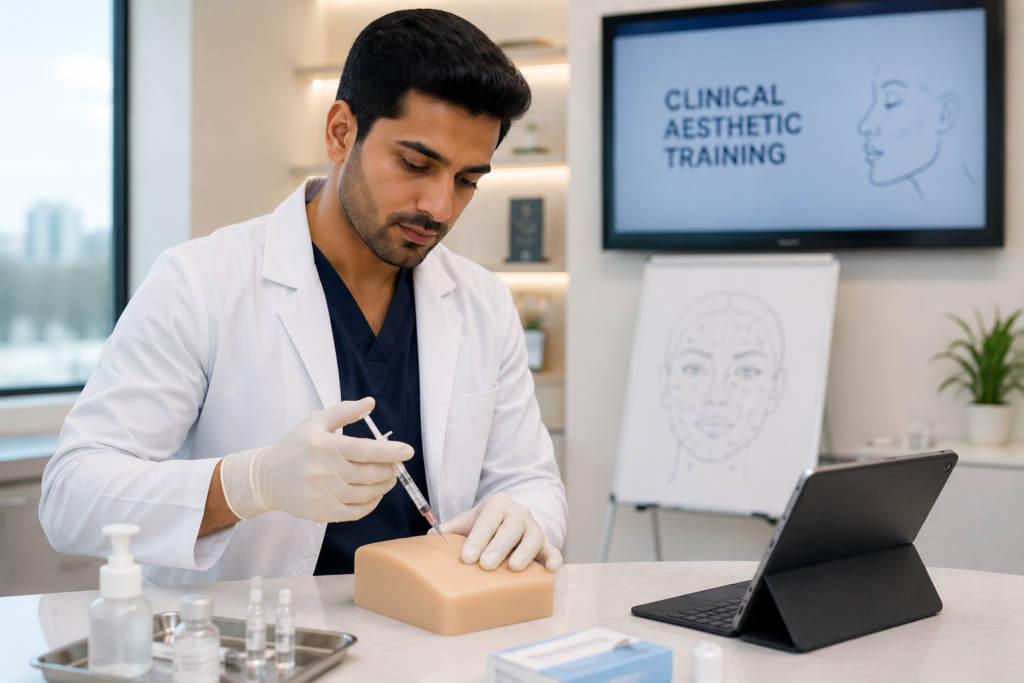
Dr. Kunal had attended several aesthetic medicine workshops over the past year.
Every seminar looked impressive. Experts performed advanced procedures confidently while participants observed carefully from their seats. The presentations were informative, the techniques looked exciting, and the certificates added value to his professional profile.
But after every session, he returned home with the same uncomfortable feeling.
He had watched many procedures.
But he had barely performed any himself.
That realization slowly started affecting his confidence.
When patients began asking him about injectables, advanced skin rejuvenation, anti-aging treatments, and aesthetic procedures, he often felt uncertain despite completing multiple training programs.
Like many aspiring aesthetic professionals, Dr. Kunal understood the theory but lacked enough practical procedural experience.
And in aesthetic medicine, observation alone is rarely enough to build real confidence.
Why Watching Procedures Alone Is No Longer Enough
Modern aesthetic medicine is becoming increasingly skill-focused and patient-driven.
Today’s patients expect doctors to communicate confidently, perform procedures precisely, explain treatment outcomes clearly, and maintain high clinical standards throughout the patient journey.
This level of confidence cannot develop through observation alone.
Many healthcare professionals entering aesthetic medicine spend significant time attending theory-based workshops where they mostly observe experts performing procedures instead of actively practicing under supervision.
While demonstrations remain important for learning concepts, aesthetic medicine requires repeated practical exposure to develop true procedural understanding and confidence.
Without hands-on experience, many aspiring professionals hesitate during real patient procedures despite strong academic knowledge.
That hesitation directly affects treatment confidence and career growth.
Why Practical Experience Matters in Clinical Cosmetology
Clinical cosmetology combines medical science with procedural precision, patient communication, and aesthetic understanding.
Procedures involving injectables, facial aesthetics, anti-aging therapies, advanced skin treatments, and cosmetic wellness require real clinical practice to master properly.
Doctors cannot fully build procedural confidence simply by watching others perform treatments.
For professionals like Dr. Kunal, confidence only started improving once he actively participated in supervised procedures and handled practical clinical situations directly.
The moment he began practicing inside real clinical environments, his understanding became more natural and patient-focused.
He stopped feeling like an observer and started thinking like a practicing aesthetic professional.
That transition changed his confidence completely.
How Hands-On Training Helps Professionals Become Industry-Ready
Modern healthcare industries increasingly reward professionals who possess both theoretical understanding and practical expertise.
ISCA Institute focuses strongly on hands-on learning environments designed specifically for healthcare professionals entering clinical cosmetology and aesthetic medicine.
Instead of limiting education to observation-based workshops alone, the institute emphasizes supervised procedural practice, live demonstrations, patient interaction, clinical observation, and real hands-on exposure.
Programs such as Clinical Cosmetology Courses, PGDCC Programs, Injectable & Facial Aesthetic Training, Advanced Skin Treatment Workshops, and Cosmetic Nutrition Courses are designed around current patient expectations and modern healthcare trends.
This practical learning approach helps aspiring professionals gradually build confidence, procedural understanding, and clinical readiness.
For many healthcare professionals, performing procedures under expert supervision becomes the most important step toward building independent confidence.
How ISCA Institute Helps Doctors Build Better Careers
Healthcare today increasingly rewards specialization, practical skill development, and patient-centered expertise.
ISCA Institute helps doctors prepare for this rapidly evolving healthcare landscape through advanced aesthetic medicine education focused on practical confidence-building and real-world clinical learning.
Doctors from MBBS, BDS, BHMS, and BAMS backgrounds are increasingly entering aesthetic medicine because the field offers stronger specialization opportunities, flexible career growth, modern healthcare exposure, and increasing patient demand.
Women professionals restarting careers are also increasingly choosing clinical cosmetology because of its adaptable and future-focused healthcare opportunities.
ISCA’s practical training model helps professionals bridge the gap between watching procedures and confidently performing them in real clinical settings.
That difference is becoming essential in modern healthcare careers.
Career Growth Opportunities in Aesthetic Medicine
The demand for advanced aesthetic procedures and cosmetic wellness treatments continues growing rapidly worldwide.
Patients actively seek anti-aging procedures, injectables, skin rejuvenation therapies, minimally invasive treatments, and confidence-enhancing skincare solutions.
This growing demand creates strong opportunities for doctors specializing in clinical cosmetology and aesthetic medicine.
Unlike overcrowded traditional healthcare sectors, aesthetic medicine allows professionals to build expertise-driven careers centered around patient transformation, visible outcomes, and personalized treatment experiences.
For many healthcare professionals, the field also offers stronger financial growth, career flexibility, and improved work-life balance.
The future of healthcare is increasingly becoming connected with aesthetics, wellness, confidence-building, and preventive care.
The Future of Aesthetic Medicine Will Reward Practical Expertise
Modern aesthetic healthcare is rapidly evolving toward skill-focused and specialization-driven practice models.
Degrees and certifications remain important, but practical procedural confidence is becoming equally valuable for long-term professional success.
Clinical cosmetology, advanced skin procedures, cosmetic nutrition, and wellness-focused healthcare are expected to continue growing significantly because patient awareness and demand continue increasing globally.
Healthcare professionals who continuously improve their practical expertise may position themselves ahead in the future healthcare industry.
Conclusion
Many aspiring aesthetic professionals continue struggling because they spend more time watching procedures instead of actively performing them during training. Modern aesthetic medicine requires much more than theoretical understanding and observation alone. Patients today expect confidence, communication, procedural precision, and personalized care supported by real clinical expertise.
Hands-on clinical exposure is becoming essential for healthcare professionals who want to build successful and future-ready careers in clinical cosmetology and aesthetic medicine.
ISCA Institute continues helping healthcare professionals build practical confidence, advanced aesthetic expertise, and industry-ready clinical skills through modern cosmetology and aesthetic medicine training programs designed for the future of healthcare.
Dr. Trishna Gupta
ISCA Institute, Pune, Maharashtra
Website: ISCA Institute
Contact: +91 92847 53707
Email: [email protected]
Recent Posts
-
 Feeling Professionally Stuck After a Career Break in a Healthcare Industry That Changes Faster Every Year
 -
 Why More Women Doctors Are Choosing Faster-Growing Career Paths Beyond Conventional Medical Practice
 -
 Struggling to Balance Career Growth, Personal Responsibilities, and Financial Independence in Traditional Medical Careers
 -
 Feeling Unprepared to Handle Real Clinical Cases After Completing Medical Courses Focused Mostly on Theory
 -
 How Skill-Based Learning Is Becoming More Valuable Than Degrees Alone in the Modern Healthcare Industry